
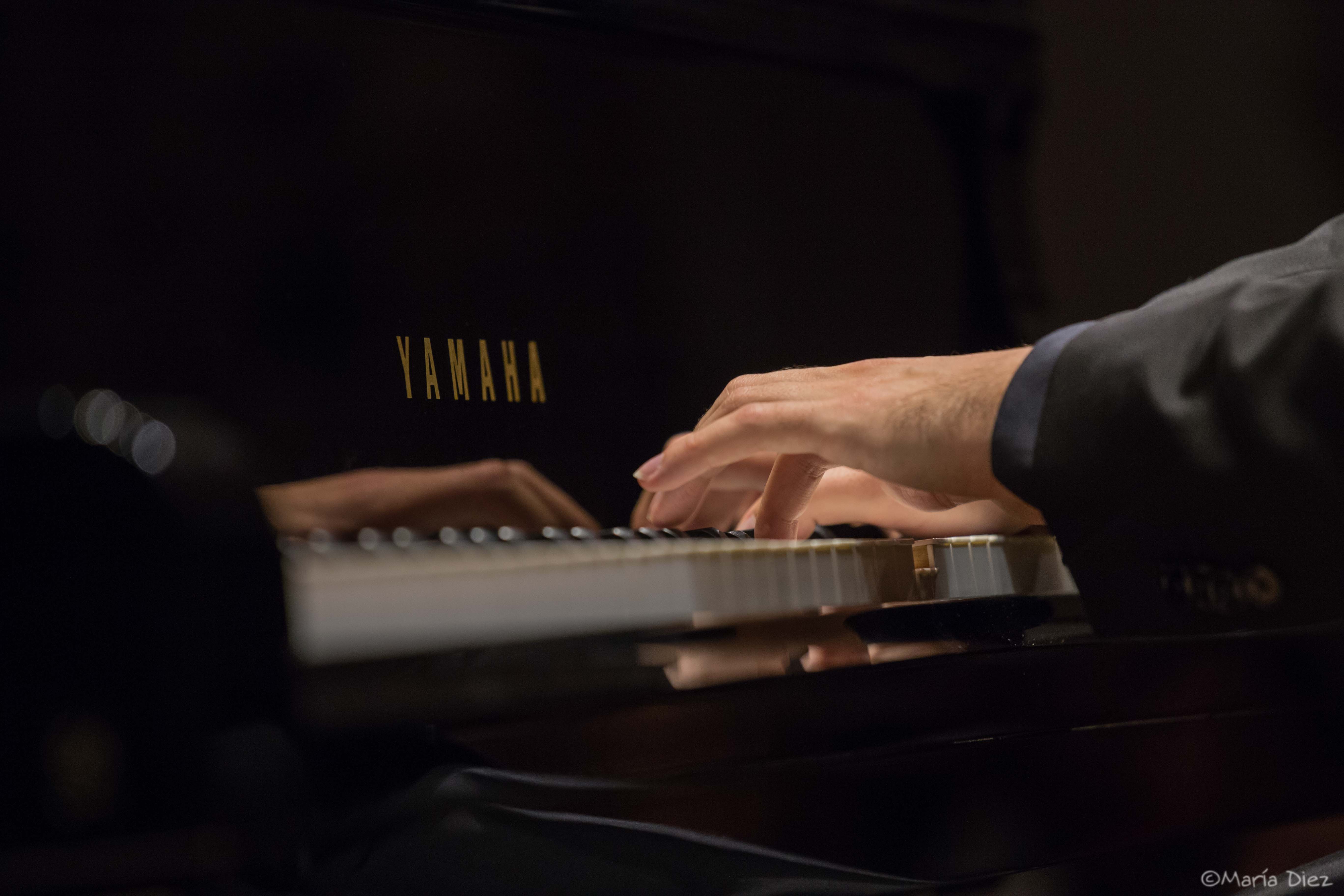
Are we listening enough? It’s never enough. I could say, Study in slow motion! does it really work? Well, there is no choice but to slow down if we want to react to all the possible details and changes that the work will demand. Listen without forgetting to dissect secondary elements, those elements that camouflage the melodies and the harmonic structure. My first piece of advice, let’s not get carried away by the first impression, our senses deceive us. Only through insistent observation can the true message be reached; a complicated challenge for a world, the one of today, so superficial and acrobatic, so simple and illogical. The problem lies in the lack of interest, or what is the same, the law of least effort. But the teacher cannot allow himself to be seduced by these tendencies, the teacher’s obligation is to make the apprentice think.
Thinking is creating, reflecting, considering… we will need a great amount of philosophical, creative and judgmental stimulation; because many ways of doing things will give us the opportunity to be able to decide and create various versions of our interpretation, just as the Canadian pianist Glenn Gould was capable of doing or what charismatic pianists such as Cyprien Katsaris or Arcadi Volodos can offer today. Examples worth following for their service to music from such an artistic, sincere and spontaneous point of view, thanks also to their improvisational mastery. As for the sound of each of them, what makes them so special? Of course, its mechanics are not (undoubtedly perfect). In my opinion, what makes them unique is the perception. A perception of course, polished and consolidated in the deepest musical rhetoric; the way of listening and understanding sound changes over time and with the musician’s own demands.
In recent years, which are the ones that have shaped my experience as a teacher, they have led me to understand that the true nature of music is not different from that of the course of life; we continuously observe cause and effect phenomenon everywhere. If we stop to think about what happens within the musical universe, we can find great similarities with respect to the behavior of the laws of physics. I mean, isn’t it obvious that we have chords with more tension than others? Yes, and it is constantly like that. That tension requires our energy and auditory intelligence; the first to generate it and the second to solve it. Therefore, the music is not static, the music continually moves towards points of tension that naturally rest accordingly; After the storm comes the calm always.
Our energy defines the result of the interpretation: the higher the impulse, the more energy; the less impulse, the less energy. The interpreter decides how to dose all that tension through his will and intellect, since the ideal is that coherence also coexists in the discourse that we develop in the interpretation. How do we generate that energy? Let’s look at dramatic art, the clear example of the most spontaneous interpretation; the actors cry in painful passages and smile in joyful passages, that is the energy. And this is what we musicians are! In my opinion, mere actors who feel, carve and modulate the sound until it becomes a living language full of emotions.
If something captures people’s attention and moves them from their seats, it is undoubtedly the uncertainty that causes tension and the pleasure that relaxation produces as a consequence, two inevitable opposite poles that make up a relief in the perspective of musical performance. Apparently this concept may seem very simple from a strictly theoretical point of view, but this polarization supposes a reflection that goes beyond a schematic concept, since experience and a high level of involvement are required; Telling a drama is not the same as living a drama. The commitment unites the performer with the sound through the matter (the instrument): if the music rises, you rise with it; If the music goes down, you go down with it.
The tension-relaxation phenomenon in music is absolutely vital to understand what happens in a melody, a phrase or a harmonic progression; It will give us focus. Each of these sections will cover points of tension and depending on their size, points with more or less energy will be given; in the night sky we observe stars with more or less luminosity. This perspective shows us the path to follow in the construction of sound from the beginning of a phrase to the end of it, constituting a birth, a climax and a decay of the material in each context. This concept is not only isolated in specific points (chords), but to the activity itself in the connection of the notes, this connection also requires energy to redirect them in a space-time (past, present and future); the chords could well be the pillars that support all that neural network. The interaction must be total, because what we are trying to do is give life to the musical text, and not only this is enough, the taste and refinement of the musician will also be decisive for a quality aesthetic result.

